
Is it possible to reduce tumor markers by 6 times in just one month—without medication? Read this inspiring story about the use of an integrative, non-pharmacological metabolic approach.
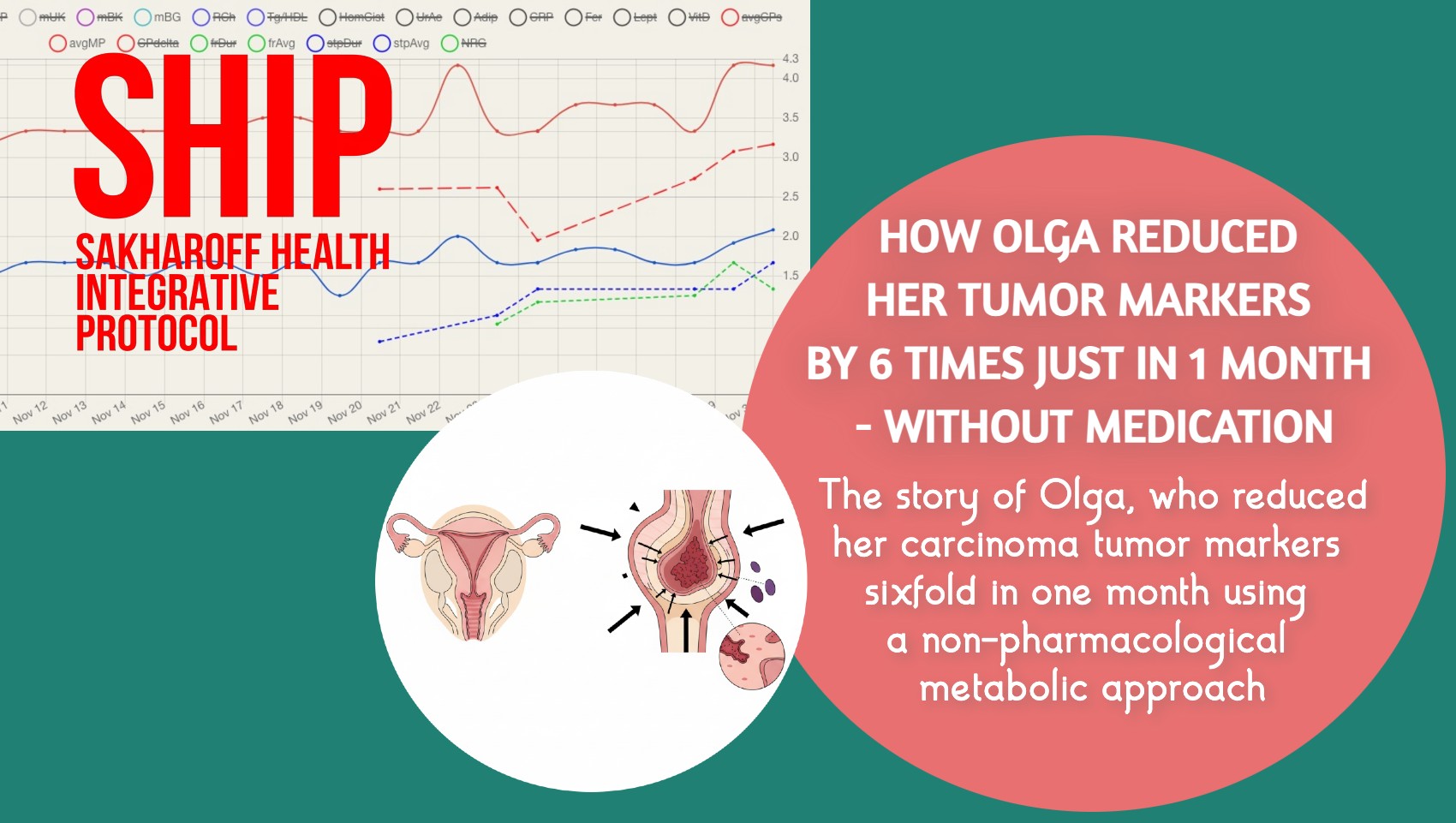
When 63-year-old Olga from Russia's test results showed that her main cancer marker was more than twice the maximum normal level, she decided to abandon standard treatment methods and take action.
Olga took responsibility into her own hands and applied to participate in BBT's intensive oncology program, which is based on a non-pharmacological metabolic approach (NPMA).
This is a story about how effectively a person can reduce their cancer risks through their own efforts if they have a clear structure, the right approach, and work on it every day.

In my practice, there are many examples of how my clients manage to reverse difficult situations and serious diagnoses thanks to structured work over several months. Today, I want to talk about how, in some cases, it is possible to significantly reduce cancer risks much faster. And I will give an example of just such a situation.
Why did the Oncology Intensive program catch her interest?
In Olga's own words:
"...I found out about you by chance — in one of the videos on YouTube, where the author simply mentioned that he went to you to learn how to breathe. I became interested... I looked at a lot of materials on the treatment of oncology. No one else approaches it as comprehensively as you do. I was very interested in your method, especially since I am currently in a crisis situation.
After surgery in 2019 to remove my gynecological organs due to cervical cancer, my squamous cell carcinoma tumor marker increased, and this can develop anywhere in the body...
I postponed my trip to the cancer center and am urgently looking for alternative treatments. I am afraid of chemotherapy, especially since my gastrointestinal tract has been very problematic since my gallbladder was removed about 20 years ago. Now I cannot cope with bile reflux, bile entering the stomach, constant gastritis, and inflammation of the duodenum. I can't tolerate many foods..."
THE MESSAGE
Yesterday, I received a joyful message from Olga on Telegram about the first positive results after a month of our joint work in the online group of the BBT intensive oncology program:
"... in the month that I was on your program, my tumor marker decreased sixfold!!!!! And I was removed from the regional cancer center's registry. I am immensely grateful to you, and at the same time, I understand that it is too early to relax, as everything can come back. And so I will follow the path you have laid out for me, I think, for the rest of my life. I have received more useful and valuable information this month than I have ever received before. Now I have seen for myself that your experience is invaluable, and that you and Yarolika's desire to help people is unique! I bow low to you!!!!"

THE RESULTS
Yes, a sixfold decrease in the main tumor marker in one month (from 3.6 to 0.6) is indeed a very good result. Now the level of this antigen (0.6) is at the lower end of its reference range (0.0–1.5). An excellent result for the first month of treatment.

Hot on the trail
This article was written immediately after I received this message. Why so quickly?
Because I felt that Olga's serious daily work following my protocol had yielded results very quickly. And I realized that such a story could inspire many people — and, most importantly, Olga herself. After all, the results of the first month are just the beginning of a wonderful lifelong process. And it is always important to continue doing what is already working — even despite such impressive initial changes.
How did she do it?
It's easiest for me to explain because I saw it with my own eyes.
Olga was very efficient. She knew that our program started every Sunday and that she had to complete the application process and interview before then.
You can join the Metabolic Health program at any time without submitting a preliminary application.
However, admission to the Intensive Support (Oncology) program is only possible after submitting an application and attending an interview.
On Friday, she watched my webinar and filled out a questionnaire, which also served as an application to participate in the program. After that, she registered for an online interview.
On Saturday, we had an online meeting on ZOOM, during which I realized that Olga's profile was a good fit for our intensive group. At the end of the interview, I gave her the green light to participate in the program. She paid for the first month, immediately received a letter describing the process of getting started, joined our closed group on Telegram, and registered in the SHIP app, where daily training takes place.
On Sunday, Olga received her first training video in the SHIP app — about how to start the intensive program so that she doesn't “lose her mind.” In other words, how to structure each day so that she takes small steps without getting overwhelmed.
On Monday, Olga already participated in her first online Q&A group session on ZOOM.
During the first month, she attended each of the three weekly Q&A sessions. And she didn't just attend — she actively participated in the process, asking questions on each week's topic, both theoretical and practical.
THE PACE OF CHANGE
I am always particularly pleased when participants start working from day one. Such people are most likely to achieve exactly what they set out to do. The participants in my intensive program are usually people with cancer diagnoses. Their goal and vision is to reverse the cancerous processes in their bodies. And I saw that Olga fully embraced the method, literally from day one. This was evident from her questions: they were practical and strictly on topic for each video.
If you work this way, changes in the body begin immediately. Of course, the pace of change will be different for each person. Despite common physiology, each organism has its own characteristics. Each case has its own level of systemic chaos, its own history, severity, and stage of disease development.
In our program, we have accumulated extensive experience working with people diagnosed with cancer. By monitoring the progress of metabolic changes—normalization of breathing, blood glucose dynamics, inflammation markers—we gradually remove the “crutches,” reducing dependence on medications and supplements and relying on the restoration of the body's innate ability to self-regulate.
Below are Olga's average weekly measurements in the SHIP app. The graphs show how her metabolic health parameters developed in just four weeks of work.
How to restore health?
There are several views on the origin of disease—and several corresponding approaches to its treatment. I will focus on two that I consider to be the most important, especially in oncology:
Standard approach (SOC traditional oncology)
SOC - Standard Of Care
Traditional oncology views cancer cells as an enemy that must be destroyed. The standard does not consider cause-and-effect relationships, nor does it attempt to change the causes in order to change the course of the disease. Hence the approach based on invasive methods — surgery, chemotherapy, radiation. However, these methods do not eliminate the causes of the disease and often lead to multiple side effects.
Philosophy:
Cancer cells = enemies that must be destroyed.
Focus:
- Remove the tumor (surgery)
- Kill the cells (chemotherapy)
- Burn the cells (radiation)
Features:
- Does not address the causes of the disease
- Puts a heavy strain on the body
- High toxicity
- Side effects often create additional problems
Process logic:
Symptom → suppression of symptom → new series of symptoms → new series of interventions
Metabolic Approach (NPMA)
About NPMA (Non-Pharmacological Metabolic Approach)
The non-pharmacological metabolic approach considers cancer cells as messengers that inform a person about an imbalance in the body: a malfunction in metabolism, hormonal functions, lymphatic system, detoxification from toxins and metabolic products, etc. Therefore, the approach to recovery is based on lifestyle changes and training of regulatory systems. We normalize cell activity, and as a result, the disease eventually disappears.
Philosophy:
A cancer cell = a messenger indicating an imbalance in the body.
Focus:
- Normalize metabolism
- Reduce systemic inflammation
- Restore hormonal regulation
- Start lymphatic cleansing
- Start the body's own self-regulation mechanisms
Tools:
- Lifestyle changes
- Breathing exercises
- Metabolic correction
- Normalization of circadian rhythms
- Mental training
- Working with glucose levels
- Structured daily habits
Process logic:
Cause → elimination of the cause → restoration of systems → disappearance of the disease
The main difference
🟥 The standard approach fights cells.
🟩 The metabolic approach restores the environment in which cells live.
Typically, for the metabolic approach to work optimally, it takes at least several months of well-structured work with constant daily support.
But sometimes the first results of such a process become noticeable after just a few weeks — as in Olga's case.
What did Olga do to change the course of her illness?
Our motto is “Education Instead of Education.” And these are not just words. In line with this motto, each program participant receives new educational material every day through the SHIP app—in the form of videos, audio, text, and short quizzes.
During the first month, each participant learns about intensive dietary changes and receives a whole set of exercises to restore movement, breathing, and mental stability. This is what makes the program truly integrative: it combines parallel changes in all areas of physiology, integrating body and spirit through physical, mental, and psychological practices.
However, it is how effectively a person applies this knowledge in practice that determines their chance of success. Olga did very well. And these are not just my words — her results are clearly reflected in the graphs in the SHIP app.
To show the trends in health changes more clearly, I selected 5 parameters (out of 25):
BASIC MEASUREMENTS IN THE PROGRAM
Morning and evening health measurements (9 measurements in the morning and evening)
- Control pause, morning (mCP), sec - time of breath holding after exhalation until the first discomfort
- Control pause, evening (eCP), sec - breath hold time after exhalation until the first discomfort
- Maximum pause, morning (mMP), sec - maximum breath hold time after exhalation
- Pulse, morning, bpm (mP), bpm/sec
- Pulse, evening, bpm (eP), bpm/sec
- Blood glucose, morning (mBG), mmol/L
- Blood ketones, morning (mBK), mmol/L
- Urine ketones, morning (mBK), mmol/L
- Energy level (1-5), evening assessment
Daily training results (7 measurements)
- 1st Buteyko exercise (3 measurements)
- Frolov trainer (2 measurements)
- Sakharoff steps exercise (2 measurements)
Note: In addition, the program includes other practices, the results of which are not included in this version of the application.
OLGA'S TRENDS AFTER 1 MONTH OF TRAINING
To show health trends more clearly, I selected 5 parameters (out of 25):
Morning and evening health measurements (2 measurements in the morning)
🔵 Morning control pause mCP, (Blue) - increased from 18 to 25 seconds. It is moving towards 60 seconds — the level of Normal Health according to the original Buteyko breathing assessment scheme (“Criteria for Pulmonary Ventilation”). According to Dr. Buteyko, it is at this level that metabolism normalizes and many chronic diseases, including cancer, begin to reverse.
🔴 Morning maximum pause mMP (red) increased from 36 to 50 seconds. This is a move towards 90 seconds — the level of Normal Health according to Buteyko's “Criteria for Pulmonary Ventilation.”
Results of daily training (7 measurements)
🔴 🔴 🔴 🔴 🔴 Buteyko exercise 1 (average maximum pause) - increased from 23 to 38 seconds
🟢 🟢 🟢 🟢 🟢 Frolov trainer (number of seconds on exhalation) - increased from 10 to 20 seconds
🔵 🔵 🔵 🔵 🔵. Steps exercise (number of steps on exhalation) - increased from 8 to 20 seconds
“OLGA'S PARADOX” - AN UNUSUAL CONCLUSION!
If you have read my previous articles, you will surely notice that this article is very different from the others.
1️⃣ The article is about a client who has only been on the program for one month. Why so soon? I usually talk about the results of clients who have been working for a long time and receive their first control indicators after 2-3 months. But in this unusual case, Olga decided to take tests for tumor markers after only one month on the program. And her experience shows that significant changes can occur almost immediately if a person starts working seriously and purposefully from day one.
2️⃣ The article is about a client who has not yet (on paper) achieved such great results as the heroes of my previous publications. And that is what I find particularly encouraging and inspiring. The fact that such seemingly small changes were enough to reverse the development of cancerous processes speaks for itself. Isn't that right?
3️⃣ I have always quoted Dr. Buteyko: to reverse metabolic diseases (including cancer), you need to reach a CP level of 60 seconds. This is indeed true. But lately, I have increasingly come to see that my main task is to help my clients understand that the most important thing is not the numbers or comparing themselves to others.
Why? Because it is not the indicator itself that heals, but the process. Stable, structured practice. Calm movement forward. Daily support for physiology. And when a person does this every day, changes occur — regardless of whether they have reached 60 seconds or are just approaching the first milestone.
1️⃣ The article is about a client who has only been on the program for one month. Why so soon? I usually talk about the results of clients who have been working for a long time and receive their first control indicators after 2-3 months. But in this unusual case, Olga decided to take tests for tumor markers after only one month on the program. And her experience shows that significant changes can occur almost immediately if a person starts working seriously and purposefully from day one.
2️⃣ The article is about a client who has not yet (on paper) achieved such great results as the heroes of my previous publications. And that is what I find particularly encouraging and inspiring. The fact that such seemingly small changes were enough to reverse the development of cancerous processes speaks for itself. Isn't that right?
3️⃣ I have always quoted Dr. Buteyko: to reverse metabolic diseases (including cancer), you need to reach a CP level of 60 seconds. This is indeed true. But lately, I have increasingly come to see that my main task is to help my clients understand that the most important thing is not the numbers or comparing themselves to others.
Why? Because it is not the indicator itself that heals, but the process. Stable, structured practice. Calm movement forward. Daily support for physiology. And when a person does this every day, changes occur — regardless of whether they have reached 60 seconds or are just approaching the first milestone.
HEALTH THROUGH THE EYES OF AN ENGINEER
Years of practice have taught me that slow processes are often the most stable and sustainable. I call this kind of process a “smart process.” By education and nature, I am an engineer, and therefore I view health restoration processes through the eyes of an engineer.
So what are the distinguishing features of such a slow “smart process”?
In the program, I teach my clients to recognize these signs in our SHIP app - and to enjoy them every day:
- Sinusoid
Trends in individual parameters often take the form of a sinusoid — with a relatively constant wavelength (the distance between horizontal peaks) and amplitude height (the distance between vertical peaks).
This suggests that in any process, after a period of good development, there will be “rollbacks.”
This is absolutely normal and is due to the body's systemic response to gradual changes in individual elements of the entire physiological system.
And in my programs, we do just that — slowly and consistently improve the parameters of the system.
- Trends
The graphs show both short-term and long-term trends.
Long-term trends can be analyzed after several months of working with the program using the “average monthly trends” function.
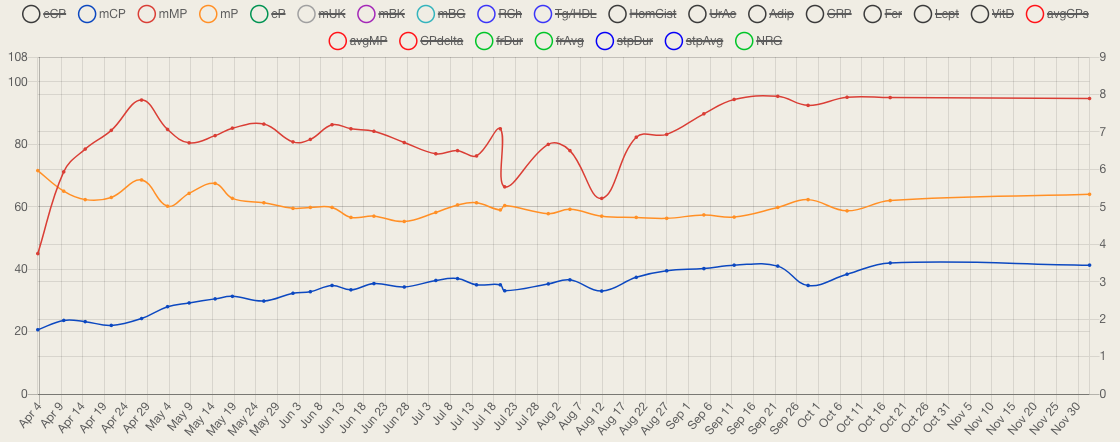
It is still difficult to see long-term trends in Olga's case, so for illustration purposes, I would like to show a graph of long-term changes based on data from one of the program participants with a stage 4 brain tumor. Over the past six months, he has already had two good control images with a pronounced positive trend (I will write a separate post about him soon). As you can see in the image, the “average monthly trends” function is enabled - “Weekly average”:

- Willpower and refusal to use it in the process.
In my opinion, everything that leads to illness is somehow related to willpower — and to the chronic stress that inevitably arises when it is constantly used. Willpower is a finite resource, and it is not advisable to rely solely on it when building a recovery process.
Therefore, I suggest that my clients honestly assess:
Do they use the “through gritting my teeth” approach in life and, most importantly, in their own recovery process?
How can this be seen?
I built the SHIP app so that the use of willpower is visible on the exercise trend graphs. For example, the following combinations signal excessive effort:
- In morning measurements: a sharp increase in the maximum pause (mMP) with a slow increase or stagnation in the control pause (mCP).
- In breathing exercises (including Buteyko exercise #1): a small increase in the control pause before and after the exercise (ΔCP) combined with a large spread between mMP and mCP.
- And many other options where inconsistent trends show that a person is “pushing” themselves instead of going at the right pace.
During the Q&A sessions, I demonstrate how to take specific steps to transition to a “smart process” — one that relies on inspiration, body awareness, and muscle relaxation rather than willpower.
One of the main tools here is diminished breathing practices. In these, I teach how to move from direct control of breathing to changing automatic patterns using the progressive active relaxation (PAR) technique. Over time, we learn to apply this technique while moving.
КАК ВОССТАНОВИТЬ ВЗАИМОСВЯЗИ
The human body is a complex system. That is why my Sakharoff Protocol (described in my Elsevier 2019 article) is designed to gradually improve each of its key components:
- breathing
- nutrition
- physical resilience (movement)
- mental resilience
- immune resilience
- and the “smart process” itself - that is, lifestyle, sleep, contact with nature, and other basic environmental conditions.

Fearlessness
Those who can build a stable process from the outset—taking small steps every day so that things don't get out of hand—will win in the long run.
This requires fearlessness.
And most often, it appears when a person's knowledge rises to a level where they begin to ask quality questions about the appropriateness of generally accepted standards in society — including standards of treatment in the field of “health care.”
New free course - "8 Unexpected Paradoxes of Health"
That's why I created the course 8 Unexpected Paradoxes of Health in my new community on Skool.com. You are welcome to join, this 9-video course is free right now.
CONCLUSION - Smart Process and Common Sense
I believe that it is best to lower tumor marker levels before a diagnosis is made. This way, you can avoid hospital visits, conversations with doctors, and all the accompanying fuss — not to mention the risks of learning about modern cancer treatment protocols.
Reducing tumor marker levels and cancer risk before diagnosis is part of my plan for maintaining metabolic health, which we are gradually working on as part of my Metabolic Health Program.
Overall, I believe it is important to reduce the risk of disease before it develops. I see this as part of what I call the “smart process” and part of what I call “my version of common sense”.
After all, we all have our own common sense. That's why our slogan is “Education Instead of Education”.
And what does your common sense tell you?
CONCLUSION - OLGA'S FEEDBACK
"I believe that Misha Sakharov's teaching method is truly unique. He generously shares his vast knowledge with all his students, giving each and every one of them his full attention.
It's no secret that learning the Buteyko breathing method is quite difficult, and I tried to do so with other teachers before meeting Misha. But I still couldn't understand what it meant to let go of my breath, to be breathed.
It was only after listening to hundreds of Misha's answers to other students' questions that I finally realized I was on the right track. I figured out a lot for myself, and now things are starting to work out.
And now, in general, I really enjoy doing all his exercises and breathing according to Buteyko and the Steps exercise and breathing on the Frolov device according to Misha's method. I believe that all these methods work, and I especially appreciate the 40-minute meditation compiled personally for me, which touches literally every string of my soul and helps me believe in my own strength.
Of course, I understand that it is too early to relax, as there is a lot of work ahead. But I want to say that I believed in Misha and Yarolika from the very beginning, and I am ready to go further and further with them, gaining unique knowledge and experience."
HAVE YOU ALSO DECIDED TO CHANGE YOUR LIFE?
Are you interested in one of my programs, but have questions?
Get a free 20-minute consultation
on your health strategy 1:1 with me 
READ MORE:
Read my article on non-invasive metabolic therapies and NPMA (Non-Pharmacological Metabolic Approach) published by Elsevier in 2019:
- Read on ReseacrhGate.net
- Download PDF
